
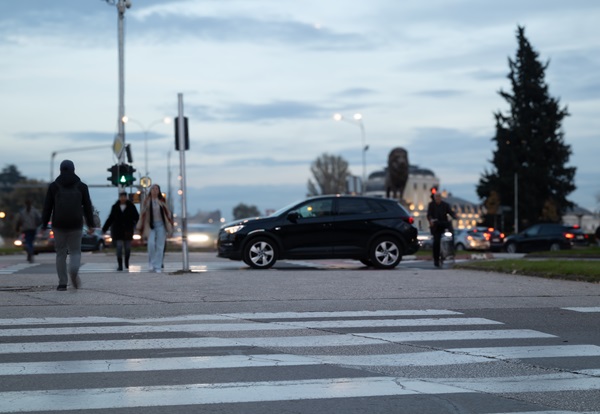
It doesn’t take much for a quiet walk across the street to turn into a close call or a serious pedestrian accident. Sometimes all it takes is the wrong car at the wrong angle, and a blind zone big enough to hide a person in plain sight. A new study from the Insurance Institute for Highway Safety sheds some much-needed light on a problem that’s been hiding right in front of us.
“Vehicles with large driver-side blind zones are much more likely to strike crossing pedestrians while turning left than those with small blind zones,” the researchers found. And when those blind spots grow, so does the danger.
What did the IIHS study uncover about blind zones and left-turn crashes?
The study reveals that the size and shape of a vehicle’s blind zone can dramatically change the odds of a pedestrian being hit during a left turn. A large driver-side blind zone raises that risk by 70 percent compared with a small one. Even medium blind zones can increase the odds by 59 percent. Thick A-pillars, bulky side mirrors, sloping windshields, and tall front ends all play a role. They’re built to protect people inside the vehicle, but they can unintentionally hide people outside of it.
“These results clearly identify problematic aspects of vehicle design,” said IIHS President David Harkey. “The challenge for automakers will be to find ways to address them that don’t diminish the protection vehicles provide to their occupants in a crash.”
To get a clear picture of how much drivers can actually see, IIHS engineers used a camera-based technique to measure blind zones on 168 vehicles. They evaluated visibility from two driver heights (5 feet 9 inches and 4 feet 11 inches) to reflect the range of people behind the wheel. Because many vehicle designs don’t change from year to year, these measurements covered a wide range of makes, models, and model years.
What did researchers find inside those numbers?
For an average-height driver, cars had the largest blind zones on the driver’s side, while pickups had the smallest. But pickups and SUVs have a narrower field of view through the windshield and a nearest visible ground point that is much farther away. For example:
- For a 5'9" driver, the average blind zone blocked 27% of the area ahead and to the left
- For a 4'11" driver, the blind zone expanded to 33%
- Both heights saw the same average windshield field of view at 88 degrees
- The nearest visible point on the ground was 26 feet ahead for the taller driver and 30 feet for the shorter one
Researchers defined small blind zones as those blocking under 20% of the view, medium as 20–30%, and large as more than 30%.
How do these blind zones affect pedestrian crash risk?
The turning movement itself plays a big role in pedestrian crash risks. A driver making a left turn must track oncoming traffic, watch the crosswalk, judge timing, and manage steering, all while parts of the vehicle may be blocking chunks of the view. After analyzing nearly 4,500 crashes across seven states, researchers found that the larger the blind zone, the more likely a pedestrian was to be struck during a left turn.
Meanwhile, in a separate analysis of 3,500 crashes, passenger-side blind zones didn’t significantly affect right-turn crashes. That makes sense since drivers have a better angle of view on that side, and right turns typically involve slower speeds and shorter sightlines.
It isn’t just the size of a blind zone that raises the risk. It’s where that blind zone falls in the driver’s field of view. For example:
- A front field of view of 85 degrees or less raised left-turn crash risk by 51%.
- A nearest visible point on the ground more than 30 feet away raised the risk by 37%.
When that visible area begins farther away, more of the space directly in front of the vehicle disappears from the driver’s sight. This scenario often leads to pedestrian accidents while turning.
Why does this matter now more than ever?
Pedestrian deaths have climbed 78 percent since 2009, reaching more than 7,300 fatalities a year. Speed and road designs play a major role. But the rise of larger vehicles (with taller hoods and bulkier frames) has made visibility a growing part of the conversation. SUVs and pickups don’t just cause more severe injuries in crashes. Their size makes it harder for drivers to see people in crosswalks, especially during turns.
Additionally, vehicle designs have shifted toward stronger structures and larger bodies over the years, often improving occupant protection. The flip side is that visibility has taken a hit, especially on the driver’s side. The study shows that even well-intentioned safety improvements can create new hazards if they block too much of the driver's view of the road.
There’s also room for improvement in several areas:
- Reimagined A-pillar structures that preserve strength while improving visibility
- Smaller or repositioned side mirrors
- Hood designs that reduce height or slope more effectively
- Windshield geometry that offers a broader field of view
What are my legal rights if I'm injured in a pedestrian accident?
If a driver’s carelessness left you injured while walking in Delaware, you have the right to seek compensation and hold the negligent party responsible. However, the process isn't as simple as it sounds, and insurance companies often use tactics to keep their costs down, even at your expense. The Delaware pedestrian accident attorneys at Gill, Welsh, and Chamberlain, P.A. can step in as your dedicated legal advocates. Our law firm represents injured pedestrians throughout Georgetown and communities across Sussex County, Kent County, and beyond.
We know how quickly medical bills, lost income, and stress can pile up, and we’re ready to step in and take the pressure off you. From investigating what happened to dealing with insurance companies, our attorneys handle every aspect of your case so you can focus on healing. You’ll never pay anything up front; we offer free consultations and work on a contingency fee basis.
You deserve answers, support, and someone who’s willing to fight for the full compensation you need. Contact us online or call today to book a free consultation. The sooner you talk with us, the sooner we can begin protecting your rights and building a strong case on your behalf.